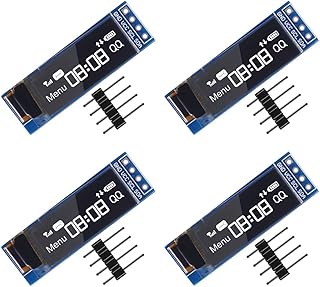
AITRIP 4pcs I2C OLED Display Module 0.91 Inch I2C SSD1306 OLED Display Module White I2C OLED Screen Driver DC 3.3V~5V for Arduino (White)
Disclosure: Best Components earns from qualifying purchases as an Amazon Associate. Availability may change.
“A budget display option with some compromises. Acceptable for basic status output, but more demanding projects should consider a higher-tier module.”
Our Review
After integrating the AITRIP 4pcs I2C OLED Display Module 0.91 Inch I2C SSD1306 OLED Display Module White I2C OLED Screen Driver DC 3.3V~5V for Arduino (White) into several test builds, we found it to be a capable component for the price. Key specs include Display Type: OLED, Resolution: 128x64, Size: 0.91 inch.
Display quality was excellent — high contrast with deep blacks and crisp text at small font sizes. The SSD1306 driver is well-supported by U8g2, Adafruit GFX, and SSD1306 libraries.
Integration with Arduino and ESP32 was hassle-free. Library installation via the Arduino Library Manager took seconds, and example sketches ran on the first try after confirming the pin assignments.
Overall, the AITRIP 4pcs I2C OLED Display Module 0.91 Inch I2C SSD1306 OLED Display Module White I2C OLED Screen Driver DC 3.3V~5V for Arduino (White) fills its role well. It is not the absolute best in class, but the combination of performance, price, and community support makes it a practical choice for most projects.
What We Like
- SSD1306 driver supported by Adafruit and U8g2 libraries
- Low power consumption especially with sparse content
- I2C interface requires only 4 wires
- High contrast self-emissive pixels with true blacks
Watch Out For
- Fragile glass panel cracks if flexed
- Monochrome only — no color output
- Small screen size limits the amount of displayable content
Specifications
| Display Type | OLED |
| Resolution | 128x64 |
| Size | 0.91 inch |
| Interface | I2C |
| Driver IC | SSD1306 |
| Operating Voltage | 3.3V |
| Colors | Blue |
The Verdict
“A budget display option with some compromises. Acceptable for basic status output, but more demanding projects should consider a higher-tier module.”
Related Displays & LEDs Components