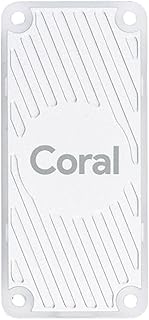
Coral USB Accelerator
Disclosure: Best Components earns from qualifying purchases as an Amazon Associate. Availability may change.
“A budget-friendly option that covers the basics. Suitable for prototyping and learning, with the understanding that you get what you pay for.”
Our Review
After integrating the Coral USB Accelerator into several test builds, we found it to be a capable component for the price. Key specs include Accelerator: Edge TPU coprocessor, Performance: 4 TOPS, Interface: M.2 (A+E key).
Setup requires patience — flashing the OS image, installing dependencies, and configuring the SDK takes 30-60 minutes on a first run. Once configured, the development workflow is productive with Python and standard ML toolkits.
Inference performance matched expectations for the hardware tier. Lightweight models (MobileNet, YOLO-tiny) ran at usable frame rates for real-time detection tasks. Larger models may need quantization to fit in available memory.
The Coral USB Accelerator earns its place in the parts bin. Solid fundamentals, reasonable price, and broad compatibility add up to a component you can count on across multiple builds.
What We Like
- Active developer community with pre-trained model zoo
- Linux-based OS supports Python and standard ML frameworks
- Dedicated hardware acceleration for neural network inference
- Runs TensorFlow Lite and ONNX models at the edge
Watch Out For
- Requires active cooling or heatsink for sustained workloads
- Limited RAM constrains large model deployment
- Initial setup and SDK installation has a learning curve
Specifications
| Accelerator | Edge TPU coprocessor |
| Performance | 4 TOPS |
| Interface | M.2 (A+E key) |
| Supported Frameworks | TensorFlow Lite |
| Power | 2W typical |
| OS Support | Linux (Debian/Ubuntu), Mendel |
The Verdict
“A budget-friendly option that covers the basics. Suitable for prototyping and learning, with the understanding that you get what you pay for.”
Related AI & Compute Components